The Creative Flow Journal · Seniors & Creativity
Beads, Pearls and Steady Hands: Jewelry Making for Seniors
Beading is a gentle workout for fingers, eyes and mind. Here is why jewelry making is such a joyful fit for seniors and adults.
Pick up a tiny bead. Line up the hole. Slide it onto the cord. Now do it again, and again, until a pattern starts to sparkle. Jewelry making looks simple, but it asks a lot of your fingers, eyes and brain all at once. That is exactly why Danielle Wilson loves bringing it to seniors and adults at Inner Vision Arts. It is beautiful, it is joyful, and it is a gentle workout for the skills we use every day.
What happens at the beading table
In our Jewelry Design workshop for seniors and adults, the focus is on fun, excitement and inspiration. Along the way, we pay attention to four kinds of skills:
- Fine motor skills: the small, careful movements of the fingers, like pinching a bead or tying a knot.
- Visual motor skills: getting the eyes and hands to work together, like guiding a cord through a tiny hole.
- Visual perception: making sense of what you see, like spotting the right size, shape or color in a busy tray.
- Thinking skills: planning a pattern, counting beads and deciding what comes next.
And at the end, everyone has a piece of jewelry they are proud to wear.
Why fine motor skills matter as we age
Our hands quietly do hundreds of jobs a day: buttoning a shirt, opening a pill bottle, writing a card. Research shows these skills change with age. A study of 98 people ages 18 to 89 found that dexterity starts to decline in middle age, with a steeper drop after 65. Interestingly, this decline was separate from hand strength. In other words, a strong grip does not guarantee nimble fingers.
Hands and minds are also connected. A review of studies on older adults found that hand dexterity and grip strength are linked with thinking skills, and that they seem to be crucial for staying independent. That does not mean beading will fix anything on its own. But it does mean that keeping your hands busy with careful, enjoyable work is a smart and happy habit.
Crafts and the aging brain
A 2015 Mayo Clinic study, reported by the American Academy of Neurology, followed 256 adults with an average age of 87. People who did crafts in both middle and old age were 45% less likely to develop mild cognitive impairment. People who did artistic activities were 73% less likely. This kind of study shows a link rather than proof, but it adds to a growing picture.
The National Institute on Aging also describes a study where older adults who learned quilting or digital photography had more memory improvement than those who only socialized. Learning a new hands-on skill seems to matter. Jewelry design fits that idea well. Each new pattern is a small puzzle to solve.
The materials are part of the magic
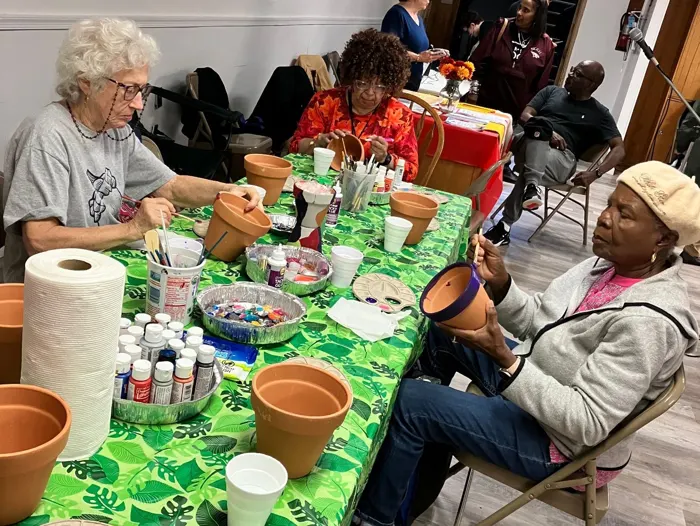
Beads, pearls, metal, cords and glass each feel different in the hand. Some are smooth and cool. Some are bumpy or light as air. Sorting, choosing and combining them engages the senses as well as the mind. Our jewelry workshops use a variety of materials like these so everyone can create a true conversation piece.
Color plays a role too. Picking colors that remind you of a person, a place or a season turns a bracelet into a story you can wear.
Joy is a real benefit
Let's not forget the simplest reason to make jewelry: it feels good. A Drexel University study found more blood flow in a reward-related area of the brain while people made art. A separate Drexel study found that about 75% of adults had lower levels of the stress hormone cortisol after 45 minutes of art making. And a 2024 study of 7,182 adults linked arts and crafts with higher happiness and life satisfaction.
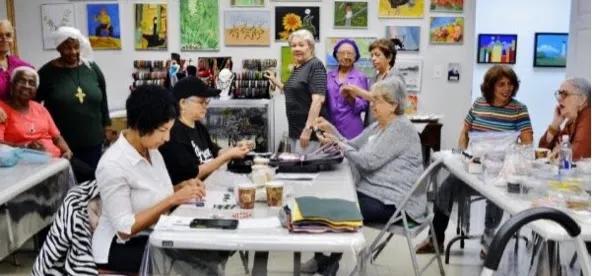
Group beading adds conversation and laughter. The NIA's page on activities you enjoy as you age suggests options like taking an art class to help maintain well-being and independence.
Tips for comfortable beading
- Start with larger beads and a stiff cord or a beading needle, then move to smaller pieces.
- Work on a tray or felt mat so beads do not roll away.
- Use bright, even lighting and take short stretch breaks for fingers and shoulders.
Therapeutic, not therapy
Our jewelry workshops are therapeutic and fun, but they are not medical treatment. Formal art therapy is practiced by credentialed art therapists. If you have specific health needs, check with your doctor or occupational therapist.
Bring the sparkle to your group
Inner Vision Arts brings jewelry design to senior centers, workplaces, special events and more. For the bigger picture on aging and creativity, read Creativity After 60. Want a warm-up? Try our online Pot Studio. Then book a jewelry workshop or call (215) 407-0344. Steady hands, bright beads and good company are waiting. Reserve your date.
By the numbers
Try this at home
- String large wooden or plastic beads onto a shoelace to warm up your fingers.
- Sort a handful of mixed beads by color, then by size, as a calm focus exercise.
- Design a three-color pattern on paper first, then bead it into a bracelet.
Want to try it virtually first? Paint a 3D pot in our Pot Studio →
Bring it to your group
Jewelry Design · Seniors & Adults with Danielle
Create jewelry you're proud to wear while keeping hands and minds sharp. We come to you, all materials included. Book at least 2 weeks ahead.
Sources
- Journals of Gerontology: Dexterous Manipulation Is Poorer at Older Ages (2014)
- Journal of Epidemiology: Handgrip Strength, Hand Dexterity and Cognitive Performance in Older Adults (2018)
- American Academy of Neurology: Can Arts, Crafts and Computer Use Preserve Your Memory? (2015)
- National Institute on Aging: Cognitive Health and Older Adults
- Drexel University: Making Art Activates Brain's Reward Pathway (2017)
- Drexel University: At Any Skill Level, Making Art Reduces Stress Hormones (2016)
- Frontiers in Public Health: Creating arts and crafting positively predicts subjective wellbeing (2024)
- American Art Therapy Association: About Art Therapy
This article shares general information about creativity and wellbeing. It is not medical or mental-health advice. Formal art therapy is provided by credentialed art therapists; Inner Vision Arts offers therapeutic, fun art workshops.